Be Quick, But Don’t Hurry: Blending Traditional and AI-Driven Approaches for Innovation
EXECUTIVE SUMMARY:
Early-stage product innovation demands a careful balance between speed and thoughtful, rigorous decision-making. This blog explores how organizations can leverage both traditional research and AI-driven synthetic respondents to accelerate product development, without compromising quality or depth.
Key highlights:
- The value of integrating traditional human insight with advanced technology for more effective idea generation and screening
- How synthetic respondents can enhance early-stage concept screening and refinement through efficient and cost-effective exploration of a wide range of concepts
- Why human validation remains essential for understanding emotional context, real-world complexity, and the “why” behind consumer choices
By adopting a hybrid, intentional approach, organizations can innovate quickly, stay grounded in real consumer needs, and achieve stronger outcomes. This balanced strategy ensures decisions are informed, purposeful, and positioned for success in today’s fast-moving markets.
Finding the Right Balance
Early-stage product innovation has always required a balance of speed, rigor, and thoughtful decision-making. Today, organizations face a dual reality: markets move faster than ever, yet the cost of premature decisions has never been higher. Teams must generate ideas, screen them, learn quickly, and move forward with confidence, without prematurely shutting down possibilities.
In today’s environment, AI-driven approaches, such as the use of synthetic respondents, are expanding the front end of innovation, allowing teams to explore more ideas with greater speed and efficiency. Yet traditional research remains indispensable for grounding decisions in real human behavior. The most effective approach isn’t choosing one over the other: it’s understanding how traditional and tech-forward methods complement each other throughout the innovation process.
One of my favorite reminders comes from legendary UCLA men's basketball coach John Wooden: “Be quick, but don’t hurry.” Nowhere is that mindset more relevant than in today’s innovation landscape — move efficiently, but never at the expense of intention.
At Bellomy, our Purposeful Innovation Platform was designed around that very principle. It blends traditional research methods with emerging tools, offering clients speed, depth, and clarity across the concept screening and early product development cycle. As such, synthetic respondents are not a replacement for human insight. But when used intentionally and within a purposeful innovation process, they can dramatically accelerate the early exploration and screening phases of product and service development.
This blog explores how these complementary approaches work together and why intentionality matters more than ever.
 The Enduring Value of Traditional Research
Traditional research methods—qualitative interviews, concept screens, iterative surveys — have long been the cornerstone of early-stage innovation. And while AI is shifting research approaches and accelerating timelines, strengths of traditional research remain essential.
However, traditional research comes with constraints that teams know well: longer timelines, higher costs, challenges reaching specific audiences, respondent fatigue, etc. These realities make it difficult to evaluate large sets of early concepts quickly, a challenge many teams now face. So while traditional research is indispensable when it comes to final decision-making, it isn’t always optimized for rapid iteration or large-scale exploratory testing.
 The Rise of Synthetic Respondents
Synthetics represent a powerful evolution in early-stage innovation. Advances in AI now allow researchers to simulate human-like responses early in the process (and in later stages as needed). These AI models, trained on extensive, representative consumer data, simulate likely responses based on real-world patterns.
While not replacements for human respondents, synthetics help teams prepare for human research. They deliver improved speed (hours instead of days or weeks), scale (large sample sizes instantly), flexibility (easy iteration), and efficiency (lower cost to explore wide spaces).
This is where the Wooden quote resonates most. Synthetics allow you to be quick — quick to explore, evaluate, and refine—but not hurried, because decisions still flow through a structured process with human validation.
 Critical Caveat: Quality Varies
The effectiveness of synthetic respondents depends entirely on how they are trained. Different models yield different results, which is why partnership with experienced developers is essential. Transparency into training approaches and guardrails leads to reliable directional insight.
Incorporating synthetic respondents into early-stage innovation isn’t about speed alone: it’s about purposeful speed. Bellomy’s Purposeful Innovation Platform emphasizes structured discipline: define what you’re trying to learn, identify where speed helps and where it introduces risk, pair synthetic iteration with human experience at the right moments. Intentional use ensures synthetic outputs inform decisions without overstepping their role.
How Traditional and Synthetic Approaches Work Together
Instead of competing, these approaches reinforce each other. Synthetics broaden exploration by enabling teams to explore large idea spaces, screen early concepts, and pressure-test assumptions. They help narrow the field, clarify questions, and reduce the number of concepts entering more expensive stages. Once synthetics filter ideas, traditional methods deepen understanding with human validation and emotional texture.
Hybrid approaches deliver stronger insights. A common structure includes a smaller human sample for grounding, a larger synthetic sample for directional clarity, and weighting to reflect appropriate influence. This blend maintains rigor while enabling speed.
Wait, What if Synthetic and Human Responses Differ?
Spoiler alert: they will (as they should). And one of the most surprising benefits of running synthetic and human data side by side is what these differences reveal about real human behavior. Differences often highlight why certain features resonate emotionally, where consumer experience plays a role, messaging nuance that matters for persuasion, and tension points where “logic” diverges from lived reality.
Simply put, when synthetics prefer Concept A and humans prefer Concept B, it sparks curiosity. Understanding why differences occur can lead to key insights around messaging, positioning, barriers, and expectations.
In one recent project, we observed notable gaps between early synthetic screens and subsequent human results. At first glance, this might seem like a limitation. But with intentional analysis, these gaps became some of the most valuable insights in the process. For example, synthetic respondents may prefer simpler, more rational concepts while humans elevate emotionally resonant features or design elements driven by preference or habit. The difference itself can tell a story, one that improves the final product, clarifies positioning, and deepens customer understanding.
To illustrate how synthetic respondents can accelerate early-stage learning, here's a recent project example. Details are adjusted for confidentiality, but the dynamics and takeaways are true to the original work.
Practical Considerations and Guardrails
To ensure speed without sacrificing rigor, teams should apply synthetic respondents intentionally. Use them to explore broad innovation territories, screen early-stage concepts, prioritize ideas before human research, or run “what-if” iterations to shape refinements. Avoid relying on them for final concept selection, detailed segmentation, pricing decisions, and high-stakes forecasting. Synthetics are a tool for exploration, not decision-making. They help teams be efficient without rushing past human validation — quick, but not hurried.
To use synthetics effectively, organizations must keep several principles in mind:
- Not all synthetics are the same: training methods differ widely.
- Partnership is crucial: collaboration ensures appropriate model use.
- Digital twin reuse must be managed carefully: previous survey experiences can influence outcome.
- Synthetics should never be the sole basis for decisions: they are an exploration tool.
- Clarity of purpose matters: use synthetics to accelerate thinking, not replace it.
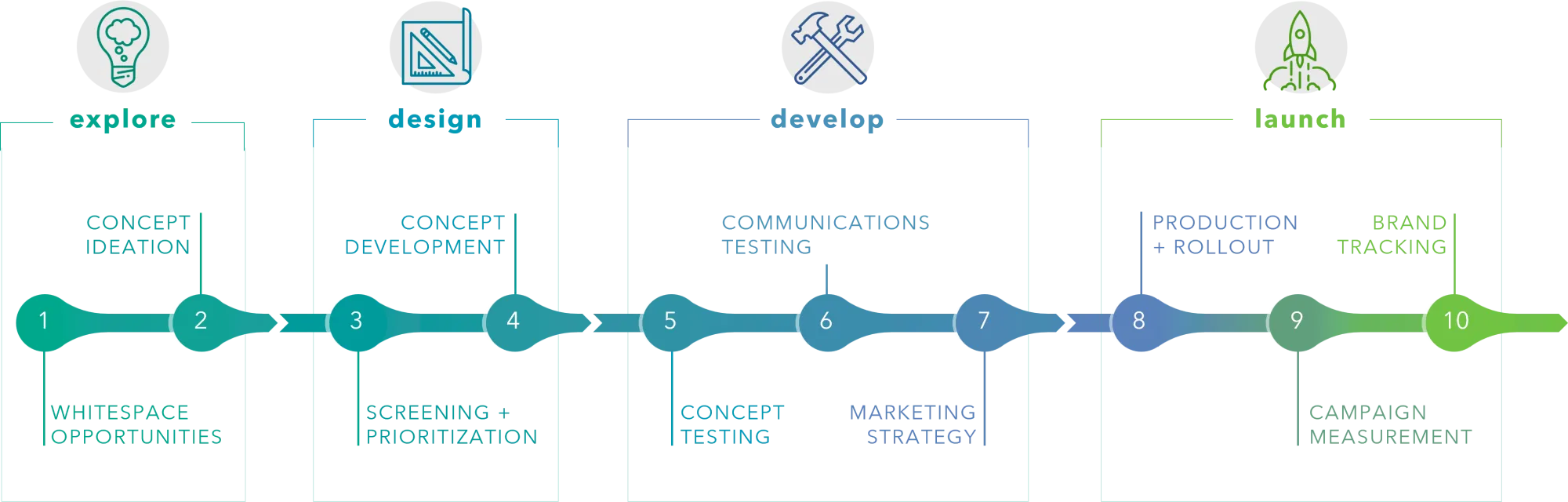
Within Bellomy’s Purposeful Innovation Platform, each tool has a defined role. Traditional research provides the human anchor. Synthetic tools expand possibilities. The process guides when and how each should be used, ensuring responsible and meaningful application. Innovation is not about choosing between human insight and AI: it’s about using both thoughtfully to generate, refine, and validate ideas more effectively.
Final Thought: A Hybrid (And Intentional) Future
Synthetic respondents help teams move quickly — but not hurriedly — through early exploration, concept screening, and idea refinement. Traditional research grounds decisions in reality. Together, they form a balanced, intentional approach to early-stage product innovation.
Early-stage innovation becomes stronger when organizations combine the strengths of human understanding with the speed and scale of AI-driven tools. Teams that adopt a hybrid approach can explore more ideas, move faster, and gain deeper insight, all while staying grounded in real consumer needs. The future of innovation is not traditional or tech-forward. It’s both, working together with purpose.
As innovation accelerates, organizations can feel pressure to make decisions faster, test more ideas, and compress timelines. Tools like synthetic respondents help meet those demands, but only when applied with intention and in partnership with experienced research teams. Early-stage product innovation is not about chasing speed. It’s about applying speed purposefully, grounding ideas in human understanding, and building processes that produce better outcomes, not just faster ones. When traditional methods and synthetic respondents work together, teams get the best of both worlds: the speed to explore broadly, the rigor to choose wisely, and the intention to innovate purposefully.
That’s how organizations meet the mark — “be quick, but don’t hurry” — and how successful products and services begin.
 If you're in the early stages of innovation and weighing the pros and cons of traditional, synthetic, and hybrid research approaches, we can help.
Bellomy's expert team can provide guidance on the best approach for your objectives, timeline, and risk tolerance so that you can move quickly without sacrificing quality. Contact us to learn more about potential options for balancing efficiency and rigor for your innovation process.