Spotlight on Digital Twins: Creation, Recommended Use Cases, and Best Practices for Market Researchers
EXECUTIVE SUMMARY: Digital twins are AI‑generated virtual copies of real consumers, built from individual-level data to mirror their behaviors, attitudes, and decision‑making processes. By combining human-sourced data with advanced behavioral modeling, digital twins offer more personalized and context-rich insights than pure synthetic respondents. This blog details Bellomy’s methodology for building digital twins, our recommended use cases, and best practices for leveraging these innovative tools to generate agile insights grounded in data from specific human respondents.
What are digital twins?
Few recent innovations in market research have generated as much interest as synthetic respondents, and digital twinning is one intriguing way to leverage synthetics for fast insights that are grounded in real data.
A digital twin is a virtual representation of a specific person, created using data collected from that individual. Twins are designed to reflect each person’s behaviors, attitudes, and decision-making processes. Unlike a basic data profile or a generic model, a digital twin is a dynamic, evolving entity—think of it as your consumer’s digital doppelganger, living within your research ecosystem.
To fully grasp the concept of digital twins, it’s important to understand what sets them apart from other types of synthetics. While there are currently varying terms and definitions across the market research industry related to different types of synthetics, for the purposes of this blog, we will use the following:
- Pure synthetics are fully AI-generated synthetic respondents, built from scratch using census data and behavioral modeling.
- Digital twins, on the other hand, are AI-generated copies of specific human respondents and can mimic their unique attitudes, sentiments, and answering patterns.
How are digital twins created?
Here is Bellomy’s process for building twins:
- We start with data that has been collected from an actual human respondent. Data can be from surveys, qualitative interviews, transaction histories, and/or other sources. Demographics, behaviors, purchase history, attitudes, and other insights are all valuable; the more data we have from a respondent, the more powerful and “life-like” their twin will be.
- Next, we identify a detailed synthetic panelist on Bellomy’s in-house synthetic panel (currently comprised of 1.4 million synthetics) that closely matches the characteristics of the human respondent.
- Then, we apply that synthetic panelist’s behavioral psychology attributes to the human respondent’s data. Attributes are characteristics that inform why individuals might make certain decisions (such as generation, life stage, socioeconomics, education, etc.). These attributes fill in the gaps in our primary data, allowing us to create more robust and “thoughtful” twins.
- Digital twins are also designed to evolve. If you have continued access to the original human respondent (e.g., through a panel or a multi-phase study), you can use new data from them to train and update their twin. For example, if a human respondent tries a new product or changes their shopping habits, the twin can update its memories and adjust its future predictions accordingly. This continual learning helps twins remain a reliable proxy for the real person as time goes on.
The AI revolution in market research is not about replacing humans—it is about amplifying what humans can do, reducing the friction often introduced by legacy methods.
Synthetics provide a tool for researchers to use for refinement, iteration and adaptation so that the real people—researchers and respondents—can focus on what's most important, not the extraneous.
—Matt Gullett | SVP, Insights Technology
What are the advantages of using digital twins instead of pure synthetics?
While other synthetic respondents might represent generalized segments or hypothetical personas, digital twins serve as faithful stand-ins for specific people. They bring a more human touch to the synthetic approach.
This distinction matters. When you use digital twins, you’re not guessing how “the average millennial” might respond; you’re modeling what your actual customer would likely do. This granularity allows for highly personalized insights and enables research at scale without losing the nuance of individual behaviors.
Plus, digital twins are always “on.” They’re always ready for new studies, new questions, and new challenges, allowing market researchers to stay agile in competitive environments.
Digital twins are especially valuable when it comes to niche, hard-to-reach audiences. For example, you might conduct primary research with a high-value subgroup of respondents whom you cannot recontact; or perhaps they’re on a panel, but you want to avoid overburdening them with repeated questions. By creating digital twins from their initial responses, you can continue to gain insights and make use of their perspectives over time, without needing to reach out to them again.
What are the ideal use cases for digital twins in market research?
Digital twins can unlock new possibilities for market researchers. Here are some of the most effective ways to use them:
- Early-Stage Concept and Message Evaluation: Get initial feedback on new product ideas or marketing messages in a risk-free environment by observing how digital twins react.
- Concept Screening: Similarly, if you’re in an early stage with many potential concepts under consideration, digital twins can help you narrow the list for further testing with human respondents.
- Enhancing a Segmentation: Whether you’re conducting a new segmentation or seeking to maximize the value of an existing segmentation, digital twins are a powerful complement. Using data from surveys and/or qualitative interviews, we can twin participants from your segmentation research, then build a custom microsite where your team can interact with them.
- Longitudinal Studies Without Attrition: See how synthetic respondents change over time through contextual prompts (for example, “It is December 2026, and the following events have occurred…”).
- Data Augmentation: Use digital twins to estimate responses from niche, hard-to-reach audiences when existing survey data is incomplete.
- Personalized Marketing: Model individual responses to tailor messages to real customer segments.
- Scenario Planning: Run “what if” analyses to anticipate market trends or consumer shifts before they happen.
Can you use twins in combination with human respondents and pure synthetics?
When using synthetics, we recommend a tiered, weighted approach:
- Humans (Direct Feedback and Validation): Collect data from a small number of human respondents and assign the highest weight to this group.
- Digital Twins (Depth and Personalization): Get feedback from a moderate-sized group of twins and assign a medium weight.
- Pure Synthetics (Scale and Coverage): Use a larger group of pure synthetic respondents and assign the lowest weight.
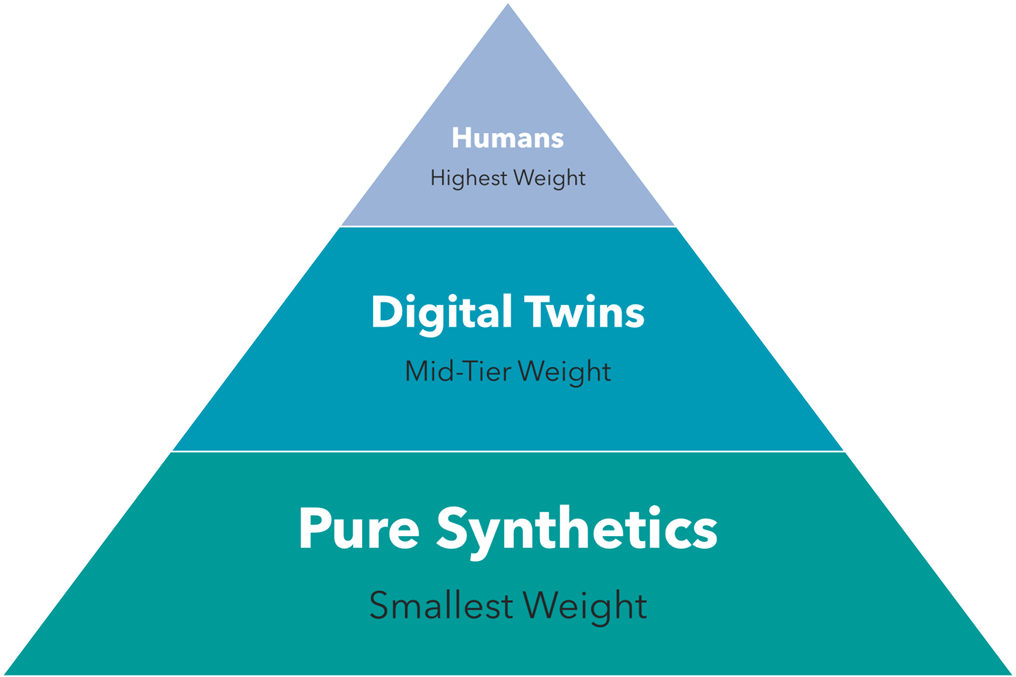
Used together, these three respondent types create a robust, flexible research framework.
Are there any limitations to using digital twins?
No technology is perfect, and digital twins are no exception. The quality of a digital twin depends on the quality of the input data and the sophistication of the modeling algorithms. Furthermore, as with any survey, established behavioral norms will apply. If a human’s survey responses are prone to error, so will their twin’s responses.
It’s also important to recognize that digital twins are tools, not replacements for human judgment or real-world validation. They’re best used in concert with traditional research methods, enhancing rather than supplanting the human element.
Above all, given that this is a fast-evolving field, researchers should always use extra caution to ensure ethical use, data privacy, and transparency in the creation and deployment of digital twins.
What's next for digital twins in market research?
As AI, machine learning, and data analytics continue to advance, digital twins will become even more powerful and accessible.
But it’s important to note that we are learning new things about synthetic respondents every day, and collaboration is a key element of success on any project that involves synthetics. A trusted partner will work with clients to align twins properly so that they deliver the greatest benefits and eliminate black-box opaqueness.
In the world of insights, embracing digital twins means staying ahead of the curve, leveraging the best of technology while keeping the human touch front and center.
 Curious about synthetics but not sure where to start? We'll walk you through options and guide you on next steps.
If you’re interested in faster, more scalable market research with synthetic respondents, let's talk. Contact Justin Bailey, VP of Strategy, to explore how Bellomy’s approach to synthetics can elevate your insights.
Want More Synthetics Insights?
Don’t settle for subpar synthetics.
Not all synthetic respondents deliver reliable insights, it’s crucial to choose solutions grounded in real-world data and rigorous validation. Bellomy’s synthetics stand apart, offering quality and trust you can count on for impactful research.
Synthetic Respondents in Market Research: The Next Frontier in Insights